Physical Address
304 North Cardinal St.
Dorchester Center, MA 02124
Physical Address
304 North Cardinal St.
Dorchester Center, MA 02124

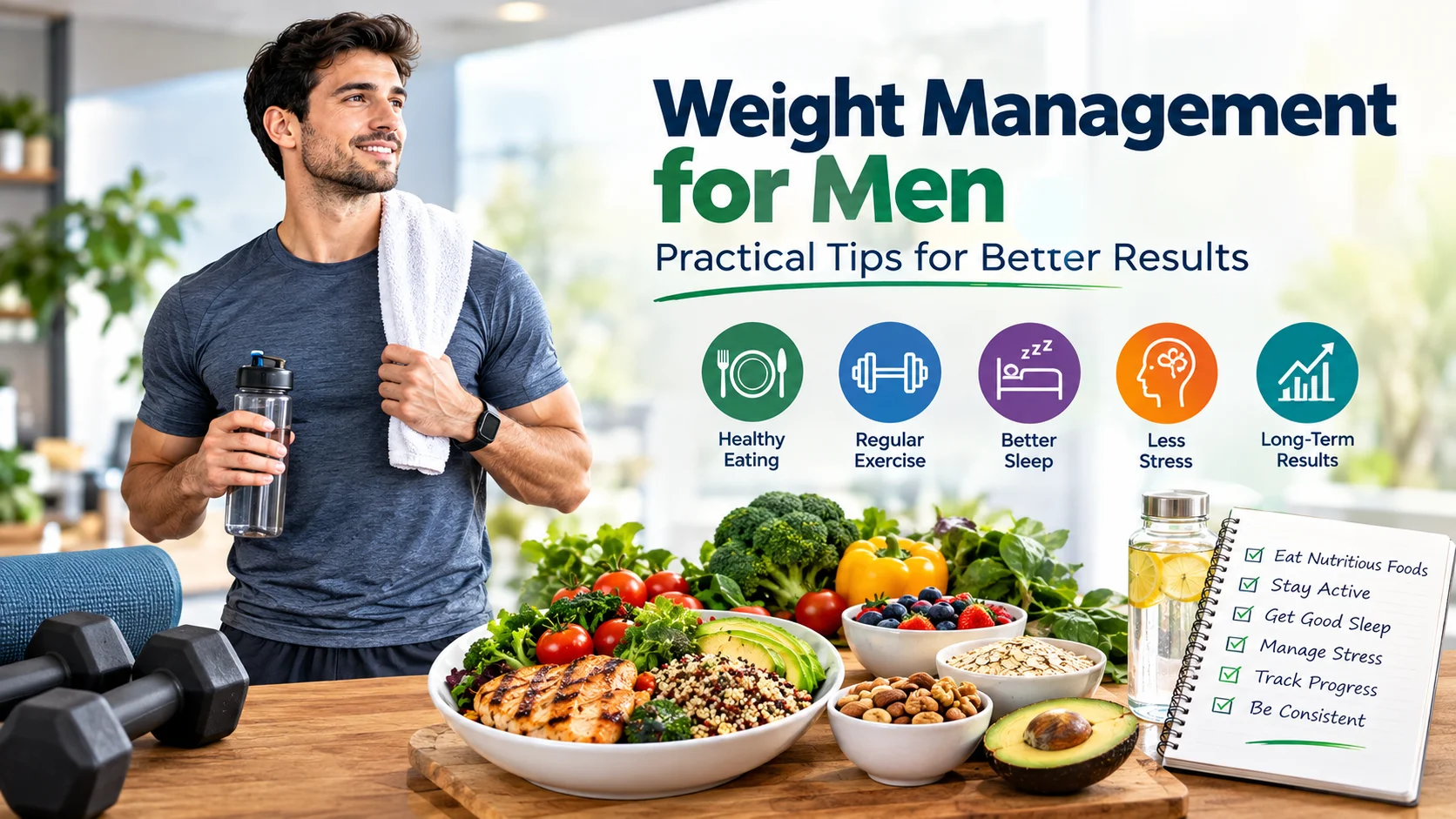
Managing your weight is not simply about trying to make the number on the scale smaller. For many men, the real goal is to improve body composition, feel more energetic, stay active, and develop eating and exercise habits that can be maintained for years.
A practical approach to weight management for men combines nutrition, physical activity, sleep, stress management, and realistic expectations. Your calorie needs can vary based on age, body size, metabolism, activity level, and other individual factors, so a plan that works for one man may not work the same way for another.
This is also why long-term weight loss management should be different from a short crash diet. Losing weight can be one goal, but keeping it off requires habits you can continue after reaching your target.
Whether your goal is losing 10 pounds, lowering your BMI, becoming more active, or working toward a major transformation, the focus should be on sustainable changes rather than unrealistic promises.

At its most basic level, body-weight change is influenced by the relationship between energy intake and energy expenditure.
Energy intake comes primarily from the food and beverages you consume. Energy expenditure includes the energy your body uses for basic functions, digestion, daily movement, exercise, and other physical processes.
When you consistently consume more energy than your body uses, body weight can increase over time. When you consume less energy than your body uses, weight generally decreases. However, real-world weight change is more complicated than a simple calorie equation because metabolism, appetite, activity, body composition, and adaptation can change as your weight changes.
This is one reason there is no universal number for men’s daily calories.
A 25-year-old man who works a physically demanding job and exercises several times a week may need substantially more food than a 55-year-old man who spends most of his day sitting. Height, weight, age, activity, and individual metabolism all influence calorie needs.
If you’re asking, “how can you maintain a healthy weight?” the answer is not necessarily to eat as little as possible. Instead, aim for an eating pattern and activity level that are appropriate for your body and realistic enough to maintain.
Your maintenance calorie level is the approximate amount of energy you need to keep your body weight relatively stable over time.
A weight-loss plan generally creates an energy deficit by reducing calorie intake, increasing activity, or using a combination of both.
The important word is sustainable.
A very large calorie deficit may produce a noticeable change on the scale initially, but it can also make hunger, fatigue, social eating, and adherence more difficult. The CDC notes that people who lose weight gradually and steadily are generally more likely to keep it off than people who lose weight faster.
Weight loss and weight management are related, but they are not identical.
Weight loss refers to reducing body weight. Weight management includes both losing weight when appropriate and maintaining the result afterward.
This distinction matters because many people focus entirely on reaching a target number. Once they reach it, they return to the eating and activity patterns that contributed to their original weight gain.
A better strategy is to ask:
Your scale can also fluctuate from day to day without representing a meaningful change in body fat. Changes in hydration, sodium intake, carbohydrate intake, food volume, bowel movements, and exercise can all influence short-term scale readings.
Therefore, looking at a longer-term trend is usually more useful than reacting to a single weigh-in.
If you’re wondering what helps u lose weight, the foundation is fairly straightforward: create an appropriate calorie deficit while building eating and activity habits that you can maintain.
For many men, the following strategies can work together:
1. Create a manageable calorie deficit
You do not need to eliminate entire food groups simply because you’re trying to lose weight. Reducing overall calorie intake while keeping meals filling can make a deficit easier to maintain.
2. Prioritize protein-rich foods
Protein can be included through foods such as eggs, chicken, turkey, fish, Greek yogurt, cottage cheese, beans, lentils, tofu, and other protein-rich choices.
Protein is particularly useful when you’re trying to preserve muscle while losing weight, especially when combined with resistance training.
3. Eat more vegetables and high-fiber foods
Vegetables, fruits, legumes, and whole grains can add volume, nutrients, and fiber to meals. This can make it easier to build satisfying meals without relying heavily on calorie-dense foods.
4. Move consistently
Walking, cycling, resistance training, swimming, sports, and other activities can increase energy expenditure and support overall health.
5. Sleep and recover
Weight management is not only about food and workouts. The CDC includes adequate sleep and stress management as components of a healthy lifestyle for weight loss.
6. Make consistency the goal
You do not need a perfect diet seven days a week.
A sustainable approach allows for birthdays, restaurants, holidays, work events, and occasional higher-calorie meals. The goal is to return to your normal routine rather than treating one meal as a reason to abandon the entire plan.
This is the practical side of healthy weight management.
Weight loss does not require expensive powders, meal-delivery subscriptions, specialty foods, or so-called “fat-burning” products.
If you’re searching for how to lose weight on a budget, start with simple foods that can be purchased in larger quantities and used across multiple meals.
Affordable options can include:
Frozen vegetables can be especially practical because they can be stored for longer periods and added to quick meals.
Meal preparation can also reduce the number of times you rely on expensive takeout. For example, you could cook chicken, rice, beans, and vegetables in batches and create several different meals using the same basic ingredients.
The idea behind “clean calories” should also be kept realistic. Food does not need to be labeled perfectly “clean” or “bad” for you to lose weight. Overall calorie intake, food quality, portion sizes, nutrient density, and dietary consistency all matter.
Likewise, superfoods and weight loss should not be treated as a magic combination. Blueberries, leafy greens, nuts, beans, and other nutrient-rich foods can be excellent additions to a diet, but no individual food automatically causes body fat to disappear.

If you’re searching for how do you lower your BMI, the basic mathematical answer is that BMI decreases when your body weight decreases relative to your height.
For adults, BMI is calculated using weight and height. CDC categories classify adult BMI below 18.5 as underweight, 18.5 to below 25 as healthy weight, 25 to below 30 as overweight, and 30 or higher as obesity.
However, BMI should not be treated as a complete measurement of health.
For example, BMI does not directly measure body fat and cannot distinguish between muscle, fat, and bone mass. A muscular man may have a relatively high BMI without having the same body-fat level as another man with the same BMI.
So if you’re asking how to get my BMI down, don’t focus exclusively on the BMI number. Consider your waist measurement, body composition, fitness, blood pressure, health history, and other relevant measures as well.
Body-fat percentage and BMI answer different questions.
BMI compares weight with height. Body-fat percentage estimates how much of your body weight comes from fat.
For men who strength train, this distinction can be particularly important. Building muscle can increase body weight even while body-fat levels remain stable or decrease.
That’s why a fat to fit transformation may not always look dramatic on the scale.
You may lose several inches around your waist while maintaining more of your muscle mass. Your clothes may fit differently even if the scale changes more slowly than expected.
For a broader assessment, waist circumference can also provide useful information. NIDDK notes that men with a waist circumference of more than 40 inches may have a higher risk of certain weight-related health problems.
If your goal is how to lower fat percent, combining an appropriate calorie deficit with resistance training and adequate protein can be more informative than chasing a particular scale number alone.
One of the most common questions in men’s weight management is: how many calories should guys eat a day?
There is no single calorie number that works for every man.
Your calorie requirements depend on factors including:
For example, an active 30-year-old man who trains regularly may have very different energy requirements from a 60-year-old man with a sedentary lifestyle.
This is why generic calorie targets found online should be viewed as estimates rather than personal prescriptions.
If you want a more individualized starting point, the NIH’s NIDDK provides a Body Weight Planner designed to estimate calorie and physical-activity changes for reaching and maintaining a goal weight in adults.
The key is to use calorie information as a planning tool—not as a reason to eat as little as possible.
The phrase “good calories vs bad calories” can be useful as a simple way to discuss food quality, but it can also oversimplify nutrition.
A calorie is a unit of energy. However, foods containing the same number of calories can have very different nutritional profiles.
For example, a meal containing protein, vegetables, whole grains, and healthy fats can provide protein, fiber, vitamins, minerals, and other nutrients. A highly processed snack may provide similar calories with considerably less nutritional value.
For good and bad calories, a better framework is to ask:
You do not have to completely eliminate foods you enjoy.
A sustainable diet can include occasional desserts, restaurant meals, or favorite snacks while still emphasizing nutrient-dense foods most of the time.
You’ll often see the claim that 3,500 calories equals exactly one pound of body fat.
Real-world weight management is more complicated.
The NIH explains that the body adapts to changes in calorie intake and expenditure, meaning weight loss does not continue in a perfectly linear way based on a fixed calorie formula.
So questions such as “how many calories to gain a pound?” or “how many calories is one kilo?” cannot be answered accurately as a universal fixed number that applies to every person.
Body weight also includes more than body fat. Changes in glycogen, water, food volume, and lean tissue can affect the scale.
For this reason, focus on trends over time rather than expecting the scale to follow a perfectly predictable mathematical line.
Knowing how to stick to a diet is often more important than finding the theoretically perfect diet.
A plan that looks excellent on paper but is impossible to follow during busy workweeks, weekends, vacations, or social events is unlikely to produce lasting results.
Instead, build a structure around your actual lifestyle.
Try these strategies:
Keep meals simple.
You do not need dozens of recipes. A few repeatable breakfasts, lunches, dinners, and snacks can make healthy eating easier.
Use flexible choices.
If you normally eat chicken and vegetables for dinner, you can occasionally choose fish, lean beef, beans, or another option without changing your entire plan.
Plan for weekends.
Many men eat consistently during the workweek and then consume substantially more calories on weekends. Planning restaurant meals, alcohol, snacks, and social events in advance can reduce this swing.
Track progress appropriately.
You can monitor body weight, waist circumference, workouts, food intake, or other measures that help you understand your progress.
Expect setbacks.
NIDDK specifically notes that setbacks are normal and recommends regrouping rather than abandoning the plan after overeating or missing activity.
The goal is not perfect adherence. It is learning how to be consistent in losing weight while still living a normal life.
Weight loss often becomes slower as time passes.
Early changes may include shifts in water and glycogen, while later progress may become less dramatic. Your body also becomes lighter, which can reduce the amount of energy you use during daily movement.
If progress slows, don’t immediately respond by dramatically cutting calories.
Instead, review:
A plateau may sometimes be a genuine period where body weight is relatively stable. In other cases, small changes in eating or activity may explain why progress has slowed.
Rather than looking for a jump start weight loss trick, return to the fundamentals.
That is the foundation of sustainable weight loss management.
There is no guaranteed number of pounds that every man can safely lose in one month.
Your results depend on your starting weight, calorie deficit, activity level, adherence, body composition, and other individual factors.
The CDC describes gradual weight loss of about 1 to 2 pounds per week as a general sustainable range for many adults.
That does not mean every man should target exactly that rate.
Someone with a higher starting weight may initially see larger scale changes, while another person may lose more slowly. Early weight loss can also include water, particularly when dietary carbohydrate and sodium intake changes.
This is why searches such as “lose 5 lbs in a month” or “how to lose seven pounds a month” should be treated as goals to discuss in the context of your individual starting point rather than guaranteed outcomes.
A useful long-term target can also be expressed as a percentage of starting body weight. NIDDK resources commonly discuss an initial goal of losing 5% to 10% of starting weight over about six months for people who need to lose weight.
If you’re asking, is it healthy to lose 3 pounds in a week, the answer depends heavily on the individual and how the loss occurs.
Three pounds of scale weight in a week does not necessarily mean three pounds of body fat.
A large early drop can partly reflect changes in water and glycogen. On the other hand, intentionally pursuing very rapid weight loss through severe calorie restriction can make it harder to obtain adequate nutrition and maintain lean mass and may be difficult to sustain.
For many adults, the CDC’s gradual 1-to-2-pound-per-week guidance provides a more sustainable reference point.
If you have a large amount of weight to lose, take medications that affect weight, or have an underlying medical condition, professional guidance can help determine an appropriate strategy.

Water weight is one reason the scale can change quickly.
Your body stores water in different compartments, and factors such as sodium intake, carbohydrate intake, hydration, exercise, and hormonal changes can influence short-term body weight.
For example, eating a particularly salty meal may cause temporary water retention. Likewise, changing carbohydrate intake can affect glycogen stores and associated water.
This means a sudden 2-pound increase does not automatically mean you gained 2 pounds of body fat.
The same principle applies in reverse.
If your weight falls quickly over several days, the change may include water and food volume rather than representing pure fat loss.
For weight change, look at longer-term trends rather than reacting emotionally to individual measurements.
A consistent routine, regular weigh-ins under similar conditions, and additional measures such as waist circumference can provide a more useful picture.
Large weight-loss goals can feel overwhelming when you look at the entire number at once. Whether the goal is 50, 60, 70, 80, or 100 pounds, a more practical strategy is to divide the process into smaller milestones.
The principles remain the same: create a sustainable calorie deficit, eat nutritious foods, stay physically active, get adequate sleep, and monitor your progress.
For men with significant amounts of weight to lose, professional guidance can also be useful, particularly when medications, medical conditions, or previous weight-loss attempts are involved.
If you’re wondering how can I lose 60 pounds, start by thinking beyond the final number.
Instead of treating 60 pounds as one enormous goal, divide it into smaller stages. For example, you might initially focus on losing 5% of your starting weight, then reassess your nutrition, activity, and progress before setting the next milestone.
A sustainable approach can include:
The phrase how to lose 60 pounds fast can be tempting, but faster is not automatically better.
Rapid approaches can be difficult to maintain and may involve unnecessarily restrictive eating. The CDC generally recommends gradual, steady weight loss rather than aggressive short-term dieting.
If you need to lose 50 or 60 pounds, consider the process as a series of manageable phases rather than one giant diet.
The question how do I lose 70 pounds requires a long-term mindset.
A 70-pound goal may take considerably longer than someone expects from online transformation stories. Your starting weight, calorie needs, activity, adherence, health conditions, medications, and changes in metabolism can all affect the timeline.
Rather than choosing an arbitrary deadline, build a repeatable routine.
For example:
Phase 1: Build the foundation
Focus on regular meals, portion awareness, protein, vegetables, walking, sleep, and hydration.
Phase 2: Establish consistency
Once the basic routine feels manageable, add structured resistance training and more planned aerobic activity if appropriate.
Phase 3: Monitor progress
Use weight trends, waist measurements, fitness improvements, and how your clothes fit to evaluate progress.
Phase 4: Adjust gradually
If progress slows, review food intake and activity rather than immediately adopting an extreme diet.
If you’re searching for how long to lose 70 lbs, there is no universally correct timeline. A medically appropriate rate can vary significantly between individuals.
Trying to force a large amount of weight loss into six months may create unnecessary pressure. A longer-term plan may be more practical for some people.
When the goal is 80 or 100 pounds, professional support becomes particularly worth considering.
A large weight-loss goal can involve nutritional, physical, behavioral, and medical considerations. A healthcare professional or registered dietitian can help evaluate your individual circumstances and develop a safer strategy.
If you’re searching for how do I lose 100 pounds, think in terms of stages.
You do not have to live your entire year as though you’re permanently “on a diet.”
Instead, focus on:
The same applies to searches such as how to lose 80 lbs or how can I lose 100 pounds in a year.
A calendar deadline should not become more important than your health or the sustainability of the process.
A weight loss holistic approach considers more than calories.
Nutrition matters, but so do physical activity, sleep, stress, daily routines, recovery, and behavior.
This is the practical meaning of holistic weight loss: instead of treating body weight as an isolated problem, consider the lifestyle factors that influence your ability to maintain healthy habits.
A comprehensive approach can include:
This approach can be especially useful for men who repeatedly lose weight and regain it.
If a diet requires you to completely change your lifestyle for eight weeks and then return to your previous habits, maintaining the result can be difficult.
The objective of healthy self weight loss should therefore be developing habits you can continue after reaching your initial target.
Lifestyle habits can influence appetite, activity, recovery, and consistency.
Sleep is one example.
Poor sleep does not automatically cause weight gain, but insufficient sleep can make healthy eating and regular exercise more difficult. Sleep also interacts with appetite and daily energy levels.
Stress is another consideration.
Some people respond to stress by eating more highly palatable foods, while others change their routines and become less active.
You don’t need to eliminate all stress to manage your weight. Instead, identify practical strategies such as walking, exercise, structured meals, relaxation activities, social support, or improving your sleep schedule.
Daily movement also matters.
You might complete a 45-minute workout and then spend most of the remaining day sitting. Increasing walking, taking stairs, doing household activities, or standing more often can help create a more active lifestyle.
The goal is not to turn every moment into exercise.
It is to make movement part of normal life.
There is no single exercise that every man must perform for weight management.
The most useful exercise is often the activity you can perform consistently while recovering adequately.
A balanced routine may include several forms of movement.
Resistance training
Weight training can help build or maintain muscle while you’re losing weight. Common movements include squats, rows, presses, hinges, lunges, and other exercises that train major muscle groups.
Walking
Walking is accessible, relatively low impact for many people, and easy to incorporate into daily life.
You can increase activity by walking during breaks, taking a short walk after meals, parking farther away, or using stairs when appropriate.
Cardio
Cycling, jogging, swimming, rowing, dancing, and other aerobic activities can increase cardiovascular fitness and energy expenditure.
HIIT
High-intensity interval training can be time-efficient, but it is not mandatory for fat loss. Beginners should build fitness gradually rather than assuming harder workouts automatically produce better results.
Recreational activity
Sports, hiking, basketball, tennis, and other activities can make exercise more enjoyable.
The CDC recommends that adults get at least 150 minutes of moderate-intensity aerobic activity each week and at least two days of muscle-strengthening activity, although individual exercise needs can vary.
If you’re interested in performance weight loss, remember that improving performance and reducing body weight are not always identical goals.
An athlete may need sufficient calories and carbohydrates to support training even while managing body composition.
Likewise, losing weight with Peloton or another exercise platform is possible, but the equipment itself does not determine whether weight loss occurs. Your overall activity, nutrition, and consistency matter.
Weight loss and weight cutting should not be confused.
Everyday fat loss is generally a gradual process involving changes in energy balance and body composition.
Weight cutting is different.
Some combat-sport athletes temporarily manipulate water, glycogen, food intake, and other factors before weigh-ins. The goal may be to temporarily reduce scale weight rather than permanently reduce body fat.
This is why questions such as how do UFC fighters cut weight should not be used as a template for ordinary weight management.
Rapid dehydration can carry significant risks.
Similarly, if you’re wondering can you cut a large amount of weight quickly before an event, the answer should not be approached like a standard weight-loss plan.
For everyday health, focus on sustainable fat loss and long-term weight management rather than temporary scale manipulation.
A weight-loss-friendly meal does not need to be complicated.
A simple plate can contain:
Protein:
Chicken, turkey, fish, eggs, Greek yogurt, lean beef, beans, lentils, tofu, or other protein-rich foods.
Vegetables:
Leafy greens, broccoli, peppers, carrots, tomatoes, green beans, cauliflower, or other vegetables.
High-fiber carbohydrates:
Oats, potatoes, beans, fruit, brown rice, quinoa, whole-grain bread, or other minimally processed carbohydrate sources.
Healthy fats:
Nuts, seeds, avocado, olive oil, and nut butters can provide useful nutrients, although portion sizes matter because fats are calorie-dense.
Fluids:
Water should generally be the primary beverage for hydration.
You don’t have to remove carbohydrates to lose weight. You also don’t have to avoid fat.
The key is fitting portions of different foods into an overall eating pattern that supports your calorie and nutrition needs.
Online searches for individual food calories are common, but looking up every food separately can sometimes make nutrition unnecessarily complicated.
For example, calorie content can vary depending on portion size and preparation.
A strawberry contains relatively few calories, while foods such as chestnuts, almonds, almond butter, raisins, and ice cream can provide substantially more energy per typical serving.
The same principle applies to meals such as:
Instead of memorizing every number, learn to estimate portions and compare foods based on both calories and nutritional value.
For example, almond butter calories can add up quickly because nut butter is energy-dense. That does not make almond butter a “bad” food. It simply means portion size matters if you’re managing calorie intake.
Similarly, raisins calories 1 tablespoon are different from the calories in a full handful.
Restaurant foods can also vary significantly.
A Jimmy John’s sandwich or a Subway teriyaki chicken meal may contain different calories depending on bread, sauces, toppings, cheese, and portion size.
When eating out, checking the restaurant’s current nutrition information can make calorie tracking easier.
Alcohol deserves attention because it provides calories while contributing relatively little nutritional value.
Alcohol contains about 7 calories per gram, and mixed drinks can contain additional calories from sugary mixers.
Common searches include:
The exact calorie count depends on serving size and what is mixed with the alcohol.
For example, a shot of distilled spirits may have fewer calories than a cocktail made with the same spirit plus sugary mixers.
However, calorie content is only one consideration.
Alcohol can also make it easier to overeat, disrupt routines, and affect sleep.
If weight management is your goal, you do not necessarily need to treat alcohol as completely forbidden. Instead, understand how it fits into your overall calorie intake and lifestyle.
For some men, lifestyle changes may be enough. Others may benefit from additional professional support.
This is especially relevant when someone has obesity, a significant amount of weight to lose, repeated weight regain, or medical factors affecting weight.
Consider discussing weight management with a qualified healthcare professional if:
Professional weight loss management can involve nutrition counseling, physical-activity planning, behavioral strategies, medical evaluation, and—when appropriate—prescription treatment.
The goal should be individualized care rather than simply purchasing the most aggressive treatment available.
If you search for wellness and weight loss near me, look for appropriately credentialed healthcare professionals and verify what services they actually provide.
Lipotropic injections are marketed by some clinics as part of weight-loss programs.
The important distinction is between a service being marketed for weight loss and having strong evidence that the service independently produces meaningful, sustained fat loss.
Some clinics may combine injections with nutrition counseling, exercise recommendations, or other services. In such cases, it can be difficult to attribute the outcome to one individual component.
If you’re considering MIC / lipotropic injections near me, ask:
Be cautious of services promising rapid, effortless fat loss.
The foundation of long-term weight management for men remains nutrition, physical activity, behavior change, and appropriate medical care.
IV therapy is another service sometimes promoted in the wellness industry.
An IV can deliver fluids and certain substances directly into the bloodstream, but hydration is not the same thing as losing body fat.
If someone loses scale weight after an IV-related change in hydration status, that should not automatically be interpreted as fat loss.
For people searching for iv drip for weight loss, it is important to ask what the treatment is specifically intended to accomplish and what evidence supports the claimed weight-loss effect.
A healthcare professional can help determine whether IV therapy is medically appropriate for a particular situation.
It should not replace an evidence-based nutrition and physical-activity strategy.
GLP-1-based medications have become an important part of modern obesity treatment.
Some medications in this category can affect appetite, food intake, and blood glucose regulation. Certain medications are approved for chronic weight management in specific patients, while others have different approved indications.
Eligibility depends on factors such as BMI, health conditions, current medications, medical history, and the specific medication.
If you are considering GLP-1 weight loss, talk with a qualified healthcare professional rather than purchasing medication from an unverified source.
Treatment can involve monitoring, dose adjustments, side-effect management, nutrition, physical activity, and follow-up.
Potential gastrointestinal side effects are among the issues that may occur with GLP-1-based medications, and individual suitability varies.
The important point is that medication does not eliminate the need for long-term weight-management habits.
A medication may be one component of treatment—not a replacement for an overall health strategy.
Lymphatic drainage massage is intended to encourage movement of lymphatic fluid and may be used in specific medical or wellness contexts.
However, temporary changes in fluid or swelling should not be confused with body-fat loss.
If your scale decreases after a treatment because of changes in fluid, that does not necessarily mean you burned a significant amount of stored body fat.
Therefore, when asking does lymphatic drainage help weight loss, separate two concepts:
Fluid movement:
Changes in swelling or fluid balance may temporarily affect measurements.
Fat loss:
Reducing body fat requires sustained changes in energy balance over time.
Lymphatic drainage should therefore not be presented as a substitute for nutrition, exercise, or evidence-based obesity treatment.
If you’re considering a wellness service as part of holistic weight loss, ask what measurable outcome the treatment is expected to produce and what evidence supports that expectation.
The most useful approach to men’s weight management is rarely the most extreme one.
A practical plan should fit your work schedule, food preferences, budget, activity level, social life, and health needs.
If you can maintain your routine during an ordinary Tuesday, a busy Saturday, a restaurant meal, and a vacation, you’re much more likely to have created a genuine lifestyle rather than a temporary diet.
That is the central idea behind weight management for men: focus not only on losing weight, but on building a system that helps you manage your health over the long term.
A sustainable weight-management plan does not need to be expensive.
In fact, some of the most useful foods for managing calories and improving nutrition are relatively affordable. The key is to build meals around simple ingredients rather than relying on expensive diet products.
If you’re searching for how to lose weight on a budget, start by creating a basic grocery list that you can reuse every week.
Affordable staples can include:
Buying larger packages can sometimes lower the cost per serving, particularly for foods that store well.
Frozen fruits and vegetables can also be useful because they have a longer shelf life and can reduce food waste.
Meal preparation is another way to control spending. Preparing several servings of a meal at once can reduce reliance on restaurant food and delivery.
For example, a simple meal-prep combination might include chicken, rice, vegetables, and beans. You can change the seasoning or add different vegetables throughout the week so the meals do not feel identical.
The phrase superfoods and weight loss can make healthy eating sound more expensive than it needs to be.
You do not need exotic berries, specialty powders, imported products, or expensive supplements to create a nutritious weight-loss diet.
Foods such as beans, oats, potatoes, eggs, cabbage, carrots, bananas, apples, frozen vegetables, and canned fish can all fit into a balanced eating pattern.
The same applies to the concept of clean calories.
Rather than trying to divide every food into “clean” and “unclean,” consider the overall nutritional value of your diet.
A meal can be simple, affordable, and nutritious without following a complicated diet label.
One of the most common questions during a weight-loss journey is how would I look if I lost weight?
Unfortunately, there is no way to predict exactly how one man’s body will look after losing a specific number of pounds.
Two men can lose the same amount of weight and experience very different visual changes.
Several factors influence the result:
A man who combines weight loss with resistance training may maintain more muscle than someone who loses weight through calorie restriction alone.
This can influence the appearance of the final transformation.
Looking slimmer is not always identical to weighing less.
Your waist circumference, posture, muscle development, clothing fit, and body composition can all affect how your body looks.
For example, a man may lose several inches from his waist while the scale changes more slowly because he is maintaining or gaining muscle.
If your goal is how can I look slimmer, focus on overall body composition rather than simply chasing the lowest possible scale weight.
Resistance training can help maintain or build muscle, while an appropriate calorie deficit can reduce body fat.
This combination may create a more noticeable physical transformation than weight loss alone.
Online before-and-after photos can be motivating, but they should not be treated as predictions.
Lighting, camera angles, posture, clothing, hydration, and flexing can dramatically change how a person looks.
Your own guy weight loss transformation will depend on your starting point and how your body responds to changes in nutrition and activity.
Instead of comparing your body with a specific transformation photo, track your own progress.
Useful measurements can include:
These measurements provide a broader picture than the scale alone.
Stretch marks are lines or streaks that can develop when the skin stretches or changes relatively quickly.
They can occur with weight gain, growth during adolescence, pregnancy, muscle growth, and other changes in body size.
Genetics also play a role.
So if you’re asking when losing weight do you get stretch marks, weight loss itself is not necessarily the only factor involved.
A person who previously gained a significant amount of weight may already have stretch marks, and these marks may remain after weight loss.
After substantial weight loss, some people notice changes in the appearance of their skin.
The degree of loose skin and the visibility of stretch marks can vary considerably.
Factors may include:
There is no guaranteed way to prevent stretch marks.
If you are concerned about significant skin changes during a major weight loss transformation, discussing your expectations with a qualified healthcare professional or dermatologist can be helpful.
The presence of stretch marks does not mean that your weight-loss effort has failed.
Successful weight management for men is often less about finding a secret strategy and more about avoiding approaches that are difficult to sustain.
One of the most common mistakes is setting an extremely aggressive weekly target.
A man may see an online transformation and assume he needs to reproduce the same rate of weight loss.
But rapid scale changes can include water, glycogen, and changes in food volume—not just body fat.
Extreme calorie restriction can also make it difficult to maintain adequate nutrition and may increase hunger and fatigue.
A better strategy is to establish a reasonable calorie deficit and monitor how your body responds over time.
Liquid calories are easy to overlook.
Soda, sweetened coffee, energy drinks, juice, cocktails, and other beverages can contribute substantial calories without making you feel as full as a solid meal.
Alcohol can add additional calories while also affecting food choices and routine.
If you’re struggling to understand why your calorie intake is higher than expected, review beverages as carefully as meals and snacks.
The scale is useful, but it should not be the only measurement.
Weight can fluctuate because of:
A man who begins resistance training may also gain or preserve muscle while losing body fat.
That can make scale progress appear slower than expected.
Consider tracking waist circumference, strength, fitness, clothing fit, and body-weight trends alongside your scale weight.
Another common mistake is trying to completely rebuild your lifestyle overnight.
Someone may suddenly attempt:
That plan may look impressive for a week.
It may also be impossible to maintain.
Instead, build habits progressively.
You might begin by improving breakfast, walking more, and adding two resistance-training sessions per week. Once those habits become routine, you can add another change.
Consistency usually matters more than making the biggest possible change on day one.
A practical routine should fit real life.
Consider creating a basic weekly structure:
Nutrition:
Build most meals around protein, vegetables or fruit, high-fiber carbohydrates, and appropriate portions of healthy fats.
Movement:
Aim for regular walking and other daily activity.
Strength training:
Perform resistance exercises regularly if medically appropriate.
Cardio:
Include aerobic activity that you enjoy and can recover from.
Sleep:
Maintain a consistent sleep schedule and aim for adequate sleep.
Monitoring:
Track your weight trend and another useful measurement, such as waist circumference.
Adjustment:
If progress stalls for several weeks, review your food intake, activity, and adherence before making major changes.
This approach turns weight management from a temporary project into an ongoing health habit.
There is no universal calorie target for every man.
men’s daily calories depend on age, height, body weight, activity level, body composition, and goals.
A calorie deficit is generally required for weight loss, but the appropriate size of that deficit varies.
If you’re asking how many calories should guys eat a day, consider using a reputable calorie calculator as a starting estimate and then monitoring your actual weight trend. For individualized guidance, a healthcare professional or registered dietitian can help.
There is no guaranteed amount of weight that every man can or should lose in one month.
For many adults, gradual weight loss is easier to maintain than rapid loss. The CDC generally describes about 1 to 2 pounds per week as a gradual pace, while emphasizing that individual results vary.
Therefore, how much weight can you realistically lose in a month depends on your starting weight, calorie deficit, activity, adherence, and individual circumstances.
Searches for normal weight loss per month kg should be interpreted as general guidance rather than a personal prescription.
If you’re wondering how do you lower your BMI, reducing body weight relative to height will generally reduce BMI.
However, BMI does not directly measure body fat and should be interpreted alongside other health information.
If you’re asking how to get my BMI down, focus on sustainable nutrition and activity rather than trying to manipulate the BMI number alone.
If you’re asking is it healthy to lose 3 pounds in a week, the answer depends on the circumstances.
Three pounds of scale weight does not necessarily equal three pounds of fat. Rapid early changes can partly reflect water and glycogen.
For many adults, the CDC’s general reference of about 1 to 2 pounds per week represents a more gradual approach.
Trying to lose 3 pounds a week through extreme calorie restriction is not an appropriate strategy for everyone.
People with significant obesity or medically supervised weight-loss plans may have different circumstances, so individualized professional guidance matters.
If you’re asking does lymphatic drainage help weight loss, it is important to distinguish fluid changes from fat loss.
Lymphatic drainage may be used to support lymphatic fluid movement in certain situations, but temporary changes in swelling or fluid are not equivalent to reducing body fat.
For long-term weight management, nutrition, physical activity, behavior change, and appropriate medical treatment remain the core strategies.
Plasma donation is not a weight-loss strategy.
A person may see temporary changes in body weight related to fluid shifts after donation, but that does not represent meaningful body-fat loss.
If your goal is weight management, do not use plasma donation as a method for reducing body fat.
Plasma donation should instead be approached according to eligibility requirements and donor-health guidance from the relevant donation organization.
The best answer to how do you stick to a diet is to make the diet realistic.
Instead of creating a plan based on foods you dislike or routines you cannot maintain, build meals around foods you enjoy that also fit your calorie and nutrition needs.
Helpful strategies include:
Learning how to stick to a diet is ultimately about creating repeatable habits rather than relying on motivation every day.
If you’re asking how can I lose 60 pounds, divide the goal into smaller milestones.
Focus on a sustainable calorie deficit, protein-rich foods, vegetables, high-fiber foods, regular physical activity, resistance training, sleep, and consistency.
If you have significant obesity, medical conditions, or a history of repeated weight regain, professional weight-management support may be appropriate.
Avoid assuming that how to lose 60 pounds means finding the fastest possible method.
The goal is to lose weight in a way that allows you to maintain the result.
If you’re asking how do I lose 70 pounds, start with your current habits rather than the entire 70-pound number.
Create a realistic nutrition strategy, increase physical activity, monitor progress, and make gradual adjustments.
A large goal may take months or longer, depending on your starting point and individual circumstances.
There is no universal answer to how to lose 70 pounds or how quickly it should happen.
If you have a large amount of weight to lose, professional guidance can help you develop an appropriate plan.
The question how can you maintain a healthy weight is ultimately about what happens after weight loss.
Maintenance generally requires continuing many of the habits that helped you lose weight.
These may include:
If you want to know how to stop putting on weight, pay attention to gradual changes rather than waiting until a large amount of weight has been gained.
Small adjustments can be easier than attempting another major diet.