Physical Address
304 North Cardinal St.
Dorchester Center, MA 02124
Physical Address
304 North Cardinal St.
Dorchester Center, MA 02124


A consistent approach to exercise can make a major difference in your strength, energy, mobility, cardiovascular health, and overall quality of life. This fitness and workout guide explains how to build an effective exercise routine whether you are a beginner, an intermediate exerciser, an athlete, or someone simply trying to live a healthier lifestyle.
A good workout program is not about exercising as hard as possible every day. Instead, it should combine the right types of exercise, appropriate training volume, recovery, nutrition, and gradual progression. Your ideal routine will depend on your age, fitness level, goals, schedule, available equipment, and whether you prefer exercising at home, outdoors, or in a gym.
A workout is a planned period of physical exercise designed to improve or maintain a particular aspect of fitness. In simple terms, a workout can include activities such as strength training, running, walking, cycling, stretching, mobility work, or sport-specific drills.
The workout meaning can vary depending on the person’s objective. Someone training for muscle growth may focus on resistance exercises, while an athlete may use speed, agility, conditioning, and strength exercises.
The basic workout concept is simple: perform purposeful physical activity consistently and progressively to create useful adaptations in the body.
Physical activity includes almost any movement that uses energy. Walking around your home, taking the stairs, gardening, or doing household chores can contribute to an active lifestyle.
Exercise is more structured. It is usually planned with a specific purpose, such as improving cardiovascular fitness, strength, flexibility, or body composition.
Training is even more organized. A training program typically follows a progression designed to achieve a particular goal. For example, an athlete may follow a structured exercise program to improve speed and performance.
This distinction matters because being physically active is valuable, but a structured exercise program can make it easier to measure progress and work toward specific fitness goals.
Regular exercise can support several areas of health and physical performance.
Cardiovascular exercise can improve aerobic fitness and help you perform daily activities with less fatigue. Strength training can improve muscular strength and endurance. Mobility and flexibility exercises can help you move more comfortably through different ranges of motion.
Exercise can also support healthy body composition, energy levels, balance, coordination, and everyday physical function.
The goal does not have to be athletic performance. For many adults, simply developing healthy fitness routines can be a practical way to become stronger, more active, and more resilient.
The five elements of fitness are commonly described as cardiovascular endurance, muscular strength, muscular endurance, flexibility, and body composition.
Understanding these elements helps you create a more balanced program instead of focusing on only one type of exercise.
Cardiovascular endurance describes how efficiently your heart, lungs, and circulatory system support prolonged physical activity.
Common activities include:
You can improve cardiovascular endurance by gradually increasing the duration or intensity of appropriate aerobic activities.
Muscular strength refers to the ability of a muscle or group of muscles to produce force.
Resistance exercises such as squats, presses, rows, deadlifts, lunges, and push-ups can contribute to strength development.
Beginners should prioritize learning proper movement patterns before attempting very heavy weights.
Muscular endurance is the ability of muscles to perform repeated contractions or sustain activity over time.
For example, performing multiple bodyweight squats, holding a plank, or completing repeated resistance-band exercises requires muscular endurance.
Strength and endurance overlap, but they are not identical. A balanced fitness program can include training for both.
Flexibility refers primarily to the ability of muscles and connective tissues to lengthen, while mobility involves the ability to actively control movement through a range of motion.
Stretching can contribute to flexibility, while controlled movements, dynamic warm-ups, and strength exercises through appropriate ranges of motion can support mobility.
Body composition refers to the relative amounts of fat mass and lean mass in the body.
Exercise, nutrition, sleep, genetics, and lifestyle all influence body composition. Rather than relying only on body weight, it can be useful to consider strength, fitness, waist measurements, performance, and other appropriate progress indicators.
A simple fitness checklist can help you monitor these different components over time.

Before creating a workout schedule, determine what you want your exercise program to accomplish.
Common goals include:
Your goal influences exercise selection, training frequency, intensity, and recovery.
A balanced fitness routine generally includes more than one training category.
A weekly program might combine:
For example, someone focused on general fitness might perform strength training three days per week, moderate cardio two or three days, and short mobility sessions throughout the week.
The best recommended routine is one you can consistently follow.
Instead of planning seven intense workouts, consider how many days you realistically have available. Include training days, recovery days, and lighter activity.
Effective planning exercise involves considering work, family responsibilities, sleep, stress, and other lifestyle factors.
A structured program may look very different for a busy beginner compared with an experienced athlete. Consistency is generally more important than creating an unnecessarily complicated schedule.
A warm-up prepares your body for exercise by gradually increasing movement and activity.
A warm-up may include light cardio, dynamic movements, mobility exercises, or easier versions of the movements you will perform during the workout.
For example, before lower-body strength training, you might begin with several minutes of easy walking followed by controlled bodyweight squats and hip mobility movements.
The main section should focus on your primary goal.
A strength workout might include compound exercises followed by accessory movements. A cardio session may involve continuous moderate-intensity activity or intervals.
Your exercise selection should match your current ability rather than simply copying an advanced athlete’s routine.
Cardio can be performed before or after strength training depending on your goals and the structure of the session.
You can also dedicate separate days to cardiovascular conditioning.
A cool-down allows you to transition gradually from exercise to normal activity.
Light walking, gentle movement, or easy mobility work can be useful after many workouts.
Recovery is part of training, not a sign that your program is failing.
Rest days give your body an opportunity to recover from training stress. Depending on your fitness level and goals, recovery can include complete rest or low-intensity activities such as walking and gentle mobility.
An effective resistance-training program contains several important elements.
Choose exercises that train the major movement patterns and muscles relevant to your goals.
Compound movements can train multiple muscle groups simultaneously, while isolation exercises allow you to focus more specifically on individual muscles.
A set is a group of consecutive repetitions of an exercise.
For example, performing 10 squats, resting, and then performing another 10 squats represents two sets of 10 repetitions.
The appropriate number of sets and repetitions depends on your exercise, training experience, goal, and program design.
Training frequency refers to how often you train a particular muscle group or fitness quality.
Beginners may make progress with relatively simple full-body programs, while intermediate exercisers often benefit from a more structured weekly split.
Rest periods allow you to recover between sets.
The appropriate rest interval depends on the exercise and goal. Heavy compound movements generally require more recovery than lighter accessory exercises.
Progressive overload means gradually increasing the training challenge as your body adapts.
Progression may involve:
Progression should be gradual rather than reckless.
Good technique helps you perform exercises efficiently and reduces unnecessary stress.
If you are learning a new movement, begin with a manageable resistance level and focus on controlled execution before increasing weight.
A beginner can often start with two or three training days per week.
A simple routine may include:
The initial objective is to develop consistency, learn fundamental movements, and gradually improve fitness.
An intermediate exercise routine can include greater training volume, additional exercise variations, and a more organized weekly structure.
An intermediate exerciser may use an upper-body/lower-body split or combine strength, cardio, and functional training across different days.
Progressive overload becomes increasingly important because simply repeating the same workout indefinitely may eventually produce slower improvements.
A practical workout schedule for intermediate fitness levels might look like this:
Monday: Upper body strength
Tuesday: Cardio
Wednesday: Lower body strength
Thursday: Recovery or mobility
Friday: Full-body strength
Saturday: Light cardio and mobility
Sunday: Rest
This is only an example. Training frequency should be adjusted according to recovery, goals, experience, and lifestyle.
Terms such as 2-2-2 workout and 3-3-3 workout plan can describe different training structures depending on the program or coach using the terminology.
Because these labels are not universally standardized, always determine exactly what the numbers represent before following a program.
A good training plan should clearly explain exercises, sets, repetitions, frequency, intensity, and progression rather than relying on an unexplained label.
There is no universal number that works for everyone.
A full-body workout may use several compound exercises followed by a small number of accessory movements. An upper-body session may include pushing, pulling, shoulder, and arm exercises. A lower-body session may include squat, hinge, single-leg, and calf movements.
The objective is not to complete the longest possible workout. The goal is to provide an appropriate training stimulus while leaving enough recovery capacity for future sessions.
Too many exercises can create unnecessary fatigue and make it harder to maintain proper form.
A thoughtful combination of specific exercise choices is generally more useful than an extremely complicated exercise routine.
A complete fitness and workout guide should include different forms of exercise because each contributes something different to overall fitness.
Strength training uses resistance to challenge your muscles.
Resistance can come from:
Compound exercises such as squats, presses, rows, and lunges involve multiple joints and muscle groups. Isolation exercises focus more directly on individual muscles.
For beginners, learning basic movement patterns and maintaining good technique should come before chasing heavier weights.
Cardio increases the demand placed on your cardiovascular system.
Popular options include:
The best cardio activity is one that fits your fitness level and that you can perform consistently.
Functional exercise focuses on movements that can improve strength, coordination, balance, stability, and control.
Examples include:
Functional training can be particularly useful for people who want fitness that supports everyday activities.
Athletes often require specialized training beyond general fitness.
Fitness training for athletes may include strength, acceleration, deceleration, agility, power, endurance, balance, and sport-specific movement patterns.
For example, a tennis player may need lateral movement and rotational power, while a distance runner may prioritize aerobic endurance and running economy.
The appropriate amount of cardio depends on your health, goals, current fitness level, and the intensity of your workouts.
Moderate-intensity activities can include brisk walking, recreational cycling, or similar activities that raise your heart rate while remaining manageable.
Adults can generally benefit from accumulating regular moderate-intensity aerobic activity throughout the week.
If you are new to exercise, start with manageable sessions and gradually increase duration.
Vigorous exercise places a greater demand on your cardiovascular system.
Examples can include running, fast cycling, or high-intensity intervals.
Vigorous training can be effective, but more intensity is not automatically better. Beginners should develop a foundation before adding demanding sessions.
Combining resistance training and cardio can provide a well-rounded fitness program.
For example:
Monday: Strength
Tuesday: Cardio
Wednesday: Strength
Thursday: Light cardio or mobility
Friday: Strength
Saturday: Walking or recreational activity
Sunday: Rest
This approach can support strength, cardiovascular fitness, and an active lifestyle without requiring intense exercise every day.
A 2 hour workout a day is not automatically better than a shorter workout.
Two hours may be reasonable for some experienced athletes whose programs require longer training sessions. However, many adults can achieve meaningful fitness improvements with much shorter workouts.
The quality, purpose, intensity, recovery, and total training load matter more than simply counting workout minutes.
No. Physical activity does not have to be extremely strenuous to provide benefits.
Walking, moderate cycling, swimming, resistance training, mobility work, and other manageable activities can all contribute to fitness.
The idea that physical activity must be strenuous to be effective is misleading. Your routine should match your current fitness level and goals.
The physical activity pyramid is a visual way of organizing different types of movement according to how frequently they can be incorporated into a healthy lifestyle.
At the foundation are often everyday activities and regular movement. More structured exercise can be added above that foundation.
The exact design of a physical activity pyramid can vary, but the underlying idea is useful: fitness should not depend entirely on formal workouts.
If you are asking where on the physical activity pyramid do sedentary activities belong, sedentary behavior is generally treated as something to minimize rather than something to actively pursue.
Long periods of sitting can often be interrupted with short movement breaks.
Standing, walking, stretching, or performing light household activities throughout the day can help reduce prolonged inactivity.
Structured exercise is important, but daily movement also matters.
Someone who completes a 45-minute workout but remains seated for most of the rest of the day has a different activity pattern from someone who exercises and also walks frequently throughout the day.
A healthy approach can combine formal training with an active lifestyle.
Fitness needs can change as people age.
Children, adolescents, adults, and older adults may have different priorities and abilities. Exercise selection should account for physical development, health status, experience, recovery capacity, and individual goals.
The statement that all types of exercise are appropriate at any age is too broad. Exercise needs to be adapted to the person.
Similarly, the idea that fitness requirements are the same for individuals of all ages is incorrect. Appropriate activity levels and exercise choices can differ substantially.
Proper technique helps you control movement and use the intended muscles effectively.
Good form is not necessarily about making every movement look identical. Body structure, mobility, experience, and exercise variations can affect how an exercise is performed.
If you are unsure how do you work out standard form, focus on controlled movement, appropriate range of motion, stable positioning, and resistance that you can manage safely.
Exercise depth should be appropriate for your mobility, body structure, experience, and the specific movement.
For example, squat depth can differ between individuals. A deeper movement is not automatically better if you cannot control it properly.
When considering how to work out depth, prioritize a comfortable and controlled range of motion and improve gradually when appropriate.
Breathing should support the movement rather than becoming an afterthought.
During resistance training, many people find it helpful to inhale during the easier portion of the movement and exhale during the more demanding portion, although breathing strategies can vary by exercise and training style.
Avoid unnecessarily holding your breath, especially if you have a medical condition for which pressure changes during exercise may be a concern.
Choose a resistance that allows you to complete the intended repetitions with controlled technique.
If you have to swing the weight, shorten the range of motion dramatically, or sacrifice posture to finish repetitions, the resistance may be too heavy.
Common mistakes include:
Proper training should prioritize quality over ego.
A weight-management program can combine resistance training, cardio, walking, and recovery.
For example:
Monday: Full-body strength + walking
Tuesday: Moderate cardio
Wednesday: Full-body strength
Thursday: Walking + mobility
Friday: Full-body strength + light cardio
Saturday: Longer walk or recreational activity
Sunday: Rest
Nutrition and overall energy balance are also important for body-weight changes.
Muscle-building programs typically emphasize resistance training with sufficient training volume and progression.
A sample week might include:
Monday: Upper body
Tuesday: Lower body
Wednesday: Rest
Thursday: Upper body
Friday: Lower body
Saturday: Optional cardio or mobility
Sunday: Rest
The specific number of sets and repetitions should be individualized.
A balanced general-fitness schedule might combine:
This can support strength, endurance, movement quality, and overall health.
Fitness training for athletes usually requires greater specificity.
A typical week might combine strength and conditioning, sport practice, speed work, agility drills, aerobic or anaerobic conditioning, and recovery.
The exact schedule should reflect the athlete’s sport and competitive calendar.
A personal trainer routine can be useful when you need individualized exercise selection, technique coaching, accountability, or program progression.
A qualified professional can help adapt exercises based on your current abilities and goals.
Start by identifying your current activity level, strength, cardiovascular fitness, mobility, training experience, and available time.
Do not compare your starting point with someone else’s advanced program.
Goals should be specific enough to guide your training but realistic enough to maintain motivation.
Instead of saying “get fit,” consider goals such as:
Your exercises should match your goals.
For general fitness, use a combination of strength, cardio, mobility, and functional movement.
For athletic performance, include exercises relevant to your sport.
Choose a schedule that fits your lifestyle.
Three consistent workouts every week are often more useful than planning six sessions and repeatedly missing them.
Record exercises, sets, repetitions, resistance, workout duration, and relevant cardio metrics.
A fitness graph can make improvements easier to visualize.
A personal exercise programme should evolve.
As your fitness improves, you may need to change exercise variations, resistance, volume, intensity, or training frequency.
If recovery worsens or your schedule changes, the program may need to become easier or shorter.
If you need to describe a typical practice program, it usually includes a warm-up, technical practice, conditioning or physical preparation, sport-specific drills, and a cool-down or recovery component.
The exact structure depends on the sport.
Strength and conditioning can improve an athlete’s ability to produce force, tolerate training, move efficiently, and perform repeated efforts.
Agility drills may involve changes of direction, acceleration, deceleration, balance, and reaction.
Speed training should be progressive and appropriate for the athlete’s experience.
Endurance requirements vary widely by sport.
A marathon runner and a basketball player both need conditioning, but their endurance programs will look very different.
Recovery is essential for athletes.
Sleep, nutrition, rest days, appropriate training loads, mobility work, and planned lower-intensity sessions can all contribute to recovery.
A group workout program can provide structure, social motivation, and coaching.
Sports classes may include activities such as tennis, swimming, cycling, martial arts, dance, or group strength training.
When choosing a class, consider instructor qualifications, exercise intensity, your experience level, and whether the activity fits your goals.

A sustainable exercise program should fit into your real life. You do not need an expensive gym membership or a complicated program to become more active.
Home workouts can be highly effective when they are structured appropriately.
Useful equipment can include:
Bodyweight exercises such as squats, push-ups, lunges, planks, glute bridges, and mountain climbers can also create a complete workout.
A gym provides access to a wider range of resistance-training equipment, cardio machines, cables, benches, and free weights.
A beginner can start with a relatively simple program rather than attempting every machine in the facility.
A good gym set workout should have a clear purpose and manageable training volume.
Outdoor exercise can make physical activity more enjoyable.
Walking, hiking, cycling, jogging, recreational sports, and outdoor bodyweight workouts can all contribute to an active lifestyle.
Women can benefit from the same major fitness categories as men, including strength, cardiovascular exercise, mobility, flexibility, and functional training.
A healthy fit body female approach should focus on strength, health, performance, confidence, and sustainable habits rather than unrealistic body standards.
Exercise programs should be adjusted when pregnancy, postpartum recovery, injuries, or medical conditions affect training needs.
Exercise can be adapted for different stages of life.
Younger adults may focus on building strength and fitness capacity, while older adults may place greater emphasis on maintaining strength, balance, mobility, cardiovascular fitness, and independence.
There is no single program that is appropriate for everyone.
The idea that healthy fitness routines are only possible in certain living environments is incorrect.
People can exercise in apartments, houses, small spaces, parks, community centers, gyms, and outdoor areas.
The key is adapting the program to available space, equipment, weather, safety, and lifestyle.
Tracking helps you understand whether your program is progressing.
You can record:
A fitness graph can show trends over time.
For example, you could track:
The goal is to identify long-term trends rather than obsess over daily fluctuations.
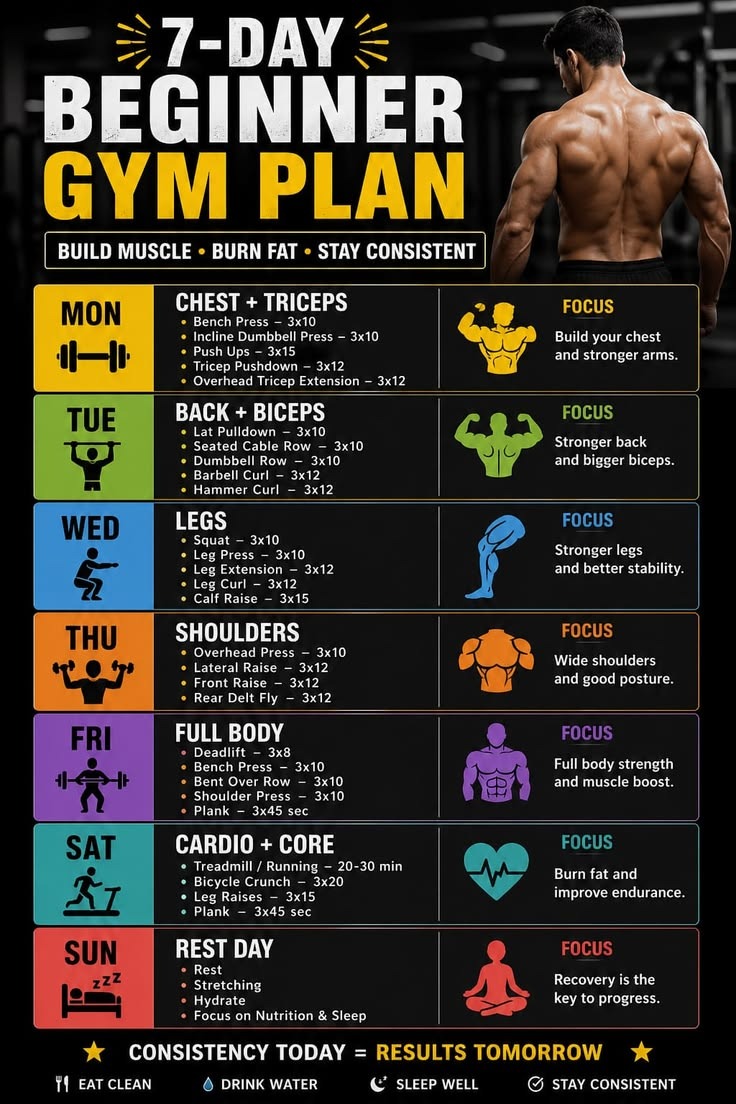
A chart of exercises can organize your weekly training.
For example:
| Day | Training | Main Focus |
| Monday | Strength | Full body |
| Tuesday | Cardio | Endurance |
| Wednesday | Strength | Lower body |
| Thursday | Mobility | Recovery |
| Friday | Strength | Upper body |
| Saturday | Cardio | Walking/cycling |
| Sunday | Rest | Recovery |
A simple fitness checklist can include:
Progressive training becomes easier when you know what you did previously.
Instead of guessing, you can use your training history to decide when an exercise should become slightly more challenging.
Images of workout movements and exercise demonstrations can be useful when learning unfamiliar exercises.
However, images should support rather than replace proper instruction. If you are unsure about a complex movement, professional coaching can be helpful.
Jump rope can provide an efficient cardiovascular workout while also challenging coordination and lower-body endurance.
Beginners can start with short intervals rather than trying to jump continuously for long periods.
Choosing the appropriate skipping rope length can make learning easier.
A rope that is too long may create unnecessary slack, while a rope that is too short can make movement difficult.
Many adjustable ropes can be modified to suit the user’s height and technique.
Walking is one of the simplest ways to increase daily activity.
You can incorporate walking by:
Fitness does not have to happen only during a formal workout.
Short periods of movement throughout the day can contribute to your total activity.
This can be particularly useful for people who spend many hours sitting at work.
Exercise frequency depends on your goals, fitness level, schedule, and recovery.
A beginner may start with two or three structured workouts per week. An intermediate exerciser may train more frequently if they can recover appropriately.
No. The claim that everyone should exercise with the same frequency ignores differences in age, training experience, goals, lifestyle, health, and recovery capacity.
Your routine should be individualized.
Rest days allow your body to recover from training stress.
Recovery can include complete rest, walking, gentle mobility, stretching, or other low-intensity activities.
If your performance continually declines and fatigue continues to increase, your program may require adjustment.
The activity factor is used in some energy-needs calculations to represent how physically active a person is.
Someone with a sedentary lifestyle generally has a different energy requirement from someone who trains intensely and remains physically active throughout the day.
Activity estimates are useful starting points but are not perfect measurements.
Blood pressure during exercise by age can vary significantly based on fitness, health status, medications, exercise intensity, and individual characteristics.
Rather than relying on a generic chart, people with cardiovascular concerns or unusually high readings should discuss appropriate exercise intensity with a healthcare professional.
More exercise is not always better.
Potential warning signs of excessive training can include persistent fatigue, declining performance, poor sleep, unusual soreness, reduced motivation, and difficulty recovering between sessions.
A 2 hour workout a day may be appropriate for some experienced athletes but unnecessary for many recreational exercisers.
Home workouts provide convenience and can reduce travel time.
Gym workouts offer greater access to equipment and can make progressive resistance training easier.
Neither option is universally better. Choose the environment that makes consistent training realistic.
Free workout plans can provide useful structure, especially for beginners.
However, a professional program may offer more individualized exercise selection, progression, technique guidance, and modifications.
A personal trainer may be helpful if you:
People with medical conditions or significant injuries should seek appropriate healthcare guidance before beginning or substantially changing an exercise program.
Choose equipment according to your training goals rather than buying everything available.
For a home program, a few adjustable pieces of equipment can often support many exercises.
Useful options may include dumbbells, resistance bands, a bench, a mat, and a jump rope.
Look for evidence based fitness programs that provide clear exercise instructions, reasonable progression, appropriate recovery, and realistic expectations.
Be cautious about programs promising dramatic transformations in extremely short periods.
A quality workout program should explain what you are doing, why you are doing it, and how you will progress.
No. Exercise intensity should match your goals and fitness level. Moderate activities can be valuable, especially for beginners.
No. Training should be individualized based on goals, experience, age, schedule, equipment, and recovery.
No. Exercise can be adapted across the lifespan, but the appropriate movements, intensity, volume, and progression can vary.
No. Excessive exercise selection can create unnecessary fatigue. Effective programming is about appropriate training stimulus and recovery.
Not necessarily. Longer workouts can be useful when they serve a specific purpose, but many people can achieve excellent results with shorter sessions.
Walking can provide meaningful cardiovascular activity and support an active lifestyle. However, depending on your goals, adding strength training and mobility work may create a more complete program.
Day 1: Full Body
Day 2: Cardio + Mobility
Day 3: Full Body
The beginner should focus on learning technique and building consistency rather than maximizing intensity.
Day 1: Upper Body
Day 2: Lower Body
Day 3: Cardio + Core
Day 4: Full Body
Day 1: Strength
Day 2: Cardio
Day 3: Strength + mobility
Day 4: Functional training + cardio
Day 5: Full-body strength
Day 6: Light recreational activity
Day 7: Recovery
This structure combines strength, cardio, mobility, functional training, and recovery.
A practical home program can combine:
You can adjust the difficulty by changing resistance, repetitions, tempo, exercise variation, or rest periods.
An athlete-focused program may include:
Strength: Compound and sport-specific resistance exercises
Conditioning: Aerobic and anaerobic work
Speed: Acceleration and sprint drills
Agility: Direction-change exercises
Recovery: Mobility, rest, sleep, and appropriate low-intensity work
The exact program should be designed around the athlete’s sport, competitive schedule, and training experience.
The best beginner routine is usually simple, manageable, and consistent. Two or three full-body sessions per week combined with regular walking and mobility work can provide a strong foundation.
A good intermediate exercise routine combines progressive strength training, cardiovascular exercise, mobility, and adequate recovery. A structured upper/lower or full-body split can work well.
There is no universal number. Choose enough exercises to train your primary movement patterns and goals without creating unnecessary fatigue.
Your cardio needs depend on intensity, goals, health, and current fitness. Regular moderate activity spread across the week is a practical foundation for many adults.
The five commonly recognized elements are cardiovascular endurance, muscular strength, muscular endurance, flexibility, and body composition.
They include exercise selection, sets, repetitions, training frequency, rest periods, progressive overload, and proper exercise technique.
The appropriate number of sets varies by exercise, goal, experience, and training program. Beginners often benefit from starting with manageable volume and progressing gradually.
Not necessarily for a highly trained athlete, but it may be unnecessary for most adults. Recovery, training intensity, nutrition, sleep, and total workload all matter.
Combine strength, cardio, mobility, flexibility, functional movement, and recovery. Start with a realistic schedule and gradually progress.
A personal trainer routine can be useful if you need individualized coaching, accountability, technique instruction, or a program designed around specific goals. However, a well-structured beginner program can also be effective when followed consistently and performed with appropriate technique.
A successful fitness and workout guide ultimately comes down to creating a routine that fits your goals and lifestyle. Start at an appropriate level, use structured exercise, prioritize proper training technique, progress gradually, and give your body enough time to recover. The most effective program is not necessarily the hardest one—it is the one you can perform consistently while making steady improvements in strength, endurance, mobility, and overall fitness.