Physical Address
304 North Cardinal St.
Dorchester Center, MA 02124
Physical Address
304 North Cardinal St.
Dorchester Center, MA 02124

If you want better fitness results, one of the most important questions to answer is how often should you work out? The right workout frequency can help you build muscle, lose weight, improve cardiovascular fitness, and stay consistent without constantly feeling exhausted.
However, more exercise does not automatically mean better results. Your ideal schedule depends on your fitness level, goals, workout intensity, recovery, sleep, nutrition, and available time. For some people, two or three workouts per week are enough to make excellent progress. Others may benefit from four, five, or even six training days when their program is properly structured.
The key is finding a weekly workout schedule that challenges your body while giving it enough time to recover.
There is no universal answer to how often should I go to the gym. A beginner may need only two or three sessions per week, while an experienced lifter may train five or six days with different muscle groups targeted throughout the week.
Your goal also matters.
For most adults, starting with 2–4 gym sessions per week is a practical approach.
Two days can work well for busy people and beginners. Three days is an excellent starting point for general fitness and full-body strength training. Four days provides more opportunities to increase training volume and can work particularly well for muscle growth and strength.
Five or six days can also work, but they are not necessary for most people. Training more frequently requires better programming, recovery, nutrition, and sleep.
When deciding how often to go to the gym, remember that consistency matters more than simply counting gym visits.
Your weekly frequency should support your specific goal rather than follow someone else’s routine.
Two workouts per week can still provide meaningful benefits, particularly when each session includes major movement patterns.
A full-body routine could include:
This approach can be especially useful for beginners, busy professionals, or anyone returning to exercise after a long break.
Three days per week is one of the easiest schedules to maintain. It provides regular training while leaving recovery days between sessions.
A simple schedule might look like:
Monday: Full Body
Wednesday: Full Body
Friday: Full Body
This setup gives you multiple opportunities to practice strength exercises without requiring daily gym visits.
Four days per week can provide a strong balance between training volume and recovery.
An upper/lower split is a popular option:
Monday: Upper Body
Tuesday: Lower Body
Thursday: Upper Body
Friday: Lower Body
This allows you to train major muscle groups more frequently while keeping rest days in the schedule.
Training five or six days can work for experienced exercisers who understand how to manage volume and intensity.
For example, an experienced person might use a push/pull/legs routine or another structured split. The important point is that working out 6 days a week does not mean every session should be extremely hard.
Some days can focus on heavier strength work while others use moderate training, mobility, technique practice, or lower-intensity cardio.
Yes. For many adults, is working out 3 days a week enough is a question with a simple answer: absolutely.
Three well-designed workouts can improve strength, fitness, mobility, cardiovascular health, and body composition. The quality of your sessions matters more than simply adding extra gym days.
If your goal is muscle growth, three full-body sessions can provide enough training stimulus when you progressively increase resistance, repetitions, or overall training volume.
For weight loss, three strength sessions combined with regular walking, cardio, and appropriate nutrition can also be highly effective.
Is working out three times a week enough depends on what you are trying to accomplish, but it is a very reasonable frequency for most beginners and recreational exercisers.
A consistent three-day routine may be more effective than a six-day plan that you cannot maintain.
Monday: Full Body
Focus on squats, pushing exercises, pulling exercises, hip-hinge movements, and core work.
Wednesday: Full Body
Use similar movement patterns while adjusting exercises, resistance, or repetitions.
Friday: Full Body
Complete another balanced session and focus on gradual progression.
Another option is:
Monday: Upper Body
Wednesday: Lower Body
Friday: Full Body
The best schedule is the one you can perform consistently while recovering between sessions.
For many people, is going to the gym 4 times a week enough is another easy question to answer: yes.
Four training days can provide enough frequency and volume for strength development, muscle growth, general fitness, and body-composition goals.
Is working out 4 days a week enough depends on workout quality, nutrition, recovery, and your specific objective.
For muscle growth, four days can allow you to train each major muscle group more than once per week. For strength, it provides enough practice with major movement patterns without requiring daily training.
For fat loss, four strength workouts can also complement cardio and increased daily activity.
Monday: Upper Body
Tuesday: Lower Body
Thursday: Upper Body
Friday: Lower Body
The Wednesday and weekend recovery periods can help manage fatigue.
Is working out twice a week enough? For many beginners, yes.
Two full-body workouts can help improve strength, movement quality, and general fitness. This frequency can also be useful for people with demanding work schedules.
The biggest advantage is consistency. If two workouts per week are realistic for you, that may be a better starting point than creating an ambitious six-day schedule that becomes difficult to maintain.
As your fitness improves, you can gradually add another training day if needed.
Should you go to the gym everyday? Not necessarily.
Going to the gym every day can be appropriate for some experienced exercisers, but attending the gym seven days per week does not mean you should perform intense workouts every day.
There is an important difference between daily physical activity and daily high-intensity training.
Yes, but your activities should be structured around your recovery ability.
For example, someone might combine:
A person who performs heavy resistance training every day without adequate recovery may experience excessive fatigue and declining performance.
It can be okay if the overall workload is appropriate. However, most people do not need intense training every day to achieve excellent results.
If you notice persistent soreness, poor sleep, declining performance, or unusual fatigue, your training schedule may need adjustment.
Is it better to workout everyday or every other day? There is no single answer because both approaches can work.
For beginners, every-other-day training can be particularly convenient because it naturally creates recovery periods.
Training every other day can provide:
For someone performing full-body strength workouts, alternating training and recovery days can be an excellent strategy.
Daily training can work when the intensity and volume are managed properly.
For example, you could perform strength training several days per week while using other days for walking, stretching, mobility, or low-intensity cardio.
The goal is not to avoid movement on rest days. The goal is to avoid continuously placing excessive stress on the same tissues and systems.
Training five or six days per week can be useful for experienced exercisers who need more training volume or enjoy frequent exercise.
However, working out 6 days a week requires more careful planning.
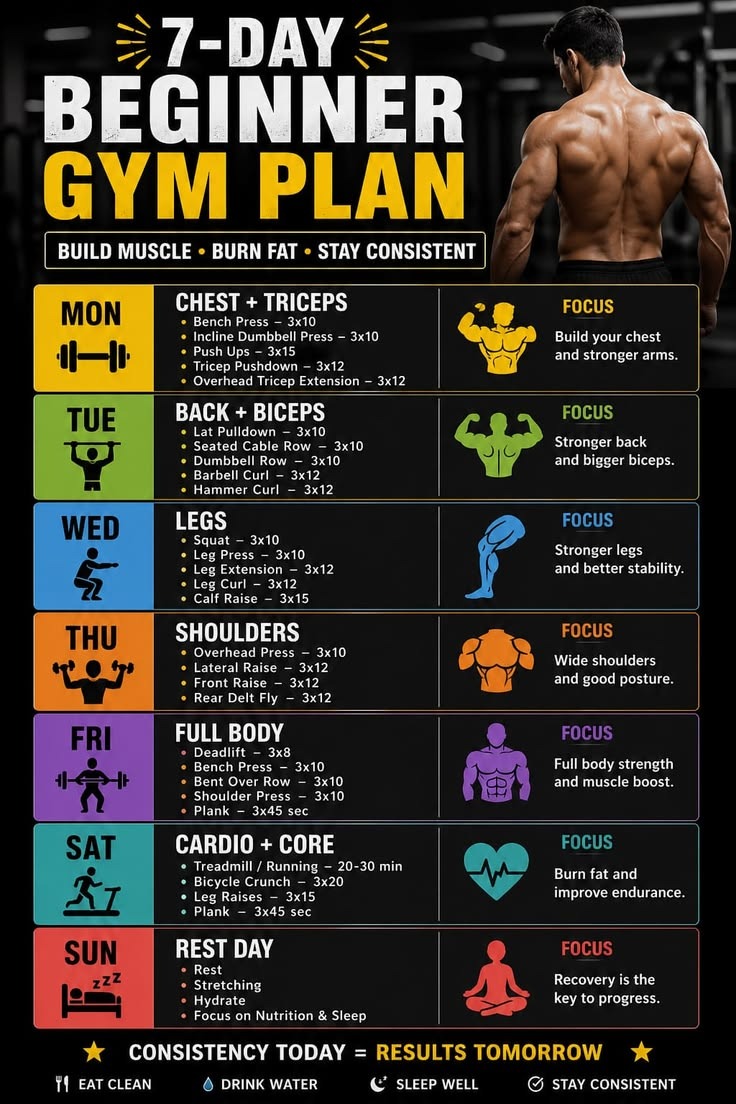
A common structure is a push/pull/legs split:
Day 1: Push
Day 2: Pull
Day 3: Legs
Day 4: Push
Day 5: Pull
Day 6: Legs
Day 7: Rest
This allows different muscle groups to receive focused training while another group recovers.
However, the schedule only works if the total workload matches your ability to recover.
Sleep, adequate nutrition, hydration, stress management, and rest all become increasingly important as training frequency increases.
Not automatically.
Exercising 6 days a week may be appropriate for some experienced people and excessive for others. Your recovery capacity, workout intensity, age, training history, and lifestyle all influence the answer.
If performance continues improving and you feel recovered between sessions, your frequency may be manageable. If you constantly feel exhausted or your performance declines, reducing volume or adding recovery may be necessary.
Workout duration is another common question. How long should a gym workout be depends on what you are doing and how efficiently you train.
A workout does not need to last two hours to be effective.
For many adults, a focused session of approximately 30–60 minutes can provide plenty of productive training.
A beginner may complete an effective workout in around 30–45 minutes.
A typical strength-training session may take approximately 45–75 minutes depending on the number of exercises and rest periods.
An advanced session may take longer, particularly when heavy compound exercises require longer recovery between sets.
How long should a gym session be? Long enough to complete your planned training with good technique and appropriate intensity.
Spending extra time in the gym is not automatically beneficial. Five focused exercises performed well can be more productive than a long session filled with unnecessary exercises.
There is no single ideal average workout time.
A practical range might look like:
The most important factors are training quality, consistency, progression, and recovery.
Yes. Is a 30 minute workout good? Absolutely.
A 30-minute workout can be highly effective when it is structured properly.
You can complete a full-body strength session, circuit workout, interval workout, or efficient cardio routine in half an hour.
To make limited workout time count:
A short workout performed consistently can produce better long-term results than an ambitious routine that you rarely complete.
Cardio frequency depends on your current fitness level, goals, and other forms of exercise you perform.
If your primary goal is general health, regular moderate-intensity cardiovascular activity can complement strength training. If you are preparing for an endurance event, your schedule may require more frequent cardio sessions.
For weight management, cardio can increase energy expenditure, but it should work alongside strength training, daily movement, nutrition, and recovery.
Is cardio everyday bad? Not necessarily.
Low-intensity activities such as walking can often be performed daily. The situation changes when every cardio session is long, intense, or demanding.
High-intensity cardio every day may make recovery more difficult, particularly when combined with hard strength training.
A balanced approach could include easy cardio on some days and harder sessions on others.
For example:
Monday: Strength + easy cardio
Tuesday: Moderate cardio
Wednesday: Strength
Thursday: Walking or recovery activity
Friday: Strength + cardio
Saturday: Longer cardio
Sunday: Rest or light movement
The ideal schedule should fit your fitness level and overall workload.
How often should I run in a week? Beginners often do well starting with two or three running sessions per week.
Running creates repetitive impact, so gradually increasing distance and intensity is important.
A beginner might start with:
Monday: Run/walk
Wednesday: Easy run/walk
Saturday: Easy run
The remaining days can include walking, strength training, mobility work, or rest.
You do not need to run every day to improve. Giving your body time to adapt can make it easier to increase running volume safely.
People training for endurance sports may eventually run more frequently, depending on their experience and training goals.
An endurance-focused schedule might include:
Not every run should be hard. Keeping most training manageable can help you accumulate volume without excessive fatigue.
If your goal is muscle growth, workout frequency is only one part of the equation.
You also need sufficient training volume, progressive overload, adequate protein and calories, quality sleep, and recovery.
Many people can make excellent progress by training major muscle groups approximately two times per week, although individual programs vary.
For example, a four-day upper/lower routine can provide repeated weekly stimulation without requiring daily full-body workouts.
Instead of asking only how many times you should visit the gym, consider how often each muscle group receives productive training.
A four-day schedule might look like:
Monday: Upper Body
Tuesday: Lower Body
Thursday: Upper Body
Friday: Lower Body
This gives each major area two dedicated training opportunities.
Another person may prefer three full-body sessions. Both approaches can work when training volume and recovery are appropriate.
The important principle is progressive overload. Over time, you should aim to gradually improve your performance through additional resistance, repetitions, better technique, or increased training capacity.
Weight loss is influenced primarily by your overall energy balance, but exercise can play an important supporting role.
A practical weight-loss routine may combine:
Strength training is particularly useful because it helps you maintain muscle while losing body weight.
No.
Doing more workouts does not guarantee faster or better weight loss.
Excessive exercise can increase fatigue, interfere with recovery, reduce workout quality, and make your routine harder to maintain.
A sustainable program that you can follow for months is generally more useful than an extreme schedule that lasts only a few weeks.
Beginners usually do not need complicated training programs.
Starting with 2–3 workouts per week gives you time to learn proper exercise technique, build consistency, and see how your body responds.
Your first goal should be establishing a habit rather than trying to maximize training volume immediately.
Start by defining your primary goal.
Do you want to:
Next, choose a realistic number of weekly sessions.
For example:
2 days: Full-body workouts
3 days: Full-body workouts
4 days: Upper/lower split
Keep sessions manageable and prioritize fundamental movements.
As your fitness improves, you can gradually increase frequency, resistance, volume, or workout complexity.
There is no perfect schedule for everyone. Use these ranges as starting points rather than strict rules.
| Goal | Practical Starting Approach |
| General fitness | 3–4 days per week |
| Beginner fitness | 2–3 days per week |
| Muscle growth | 3–5 days per week |
| Weight loss | Strength + cardio + daily movement |
| Endurance | Regular cardio/endurance sessions |
| Advanced training | Higher frequency with planned recovery |
Your actual schedule should also account for your work, family responsibilities, sleep, stress, and previous training experience.
Someone with a demanding job and limited sleep may get better results from three excellent workouts than from six poorly recovered sessions.

Rest is part of training rather than something that prevents progress.
During recovery, your body adapts to the stress created by exercise. Adequate recovery can help you return to your next workout with better energy and performance.
Rest days can support:
Rest does not always mean lying on the couch all day. Walking, gentle mobility work, and other low-intensity activities can be appropriate forms of active recovery.
Taking a week off from exercise occasionally is not automatically harmful.
Life happens. Travel, work commitments, family responsibilities, illness, accumulated fatigue, or simply needing a mental break can all make a short training break reasonable.
If you are physically and mentally exhausted, a short break may help you return with more motivation.
A week away from structured training is unlikely to erase your long-term progress.
However, if you have been inactive for a long period, returning gradually is usually more sensible than immediately attempting your previous workout volume.
After a break, reduce the initial workload and allow your body to readjust.
Increasing workout frequency can become counterproductive when your body cannot recover from the workload.
Potential warning signs include:
One difficult workout does not mean you are overtraining. Look for persistent patterns.
If performance continues declining despite adequate nutrition and sleep, consider reducing training volume or frequency and allowing more recovery.
One of the biggest mistakes beginners make is focusing only on frequency.
A better framework is:
Frequency + Intensity + Volume + Recovery + Nutrition + Sleep = Long-Term Results
For example, three high-quality strength workouts may produce better results than six poorly planned sessions.
If you increase workout frequency, you may need to manage intensity or volume.
Similarly, if you dramatically increase training intensity, additional recovery may become necessary.
This is why a person who trains four days per week should not automatically copy a six-day routine from an experienced athlete.
Your program should match your current ability to recover.

Best for:
A full-body routine on two nonconsecutive days can cover major movement patterns.
Best for:
Monday, Wednesday, and Friday is a simple structure that provides recovery between sessions.
Best for:
An upper/lower split works particularly well because each major muscle group can receive repeated weekly training.
Best for:
A five-day routine might use a combination of upper-body, lower-body, and specialized sessions.
Best for:
A six-day schedule requires careful management of volume, intensity, nutrition, and sleep.
The fact that a six-day program is possible does not mean it is superior for everyone.
More sessions can create more fatigue if recovery is inadequate.
Long workouts are not automatically better. Focus on productive exercises and appropriate rest periods.
An experienced athlete may tolerate training volume that is inappropriate for a beginner.
Training creates the stimulus, but recovery depends heavily on adequate nutrition and sleep.
Give a well-designed program enough time to evaluate progress instead of changing exercises every few days.
The best workout frequency is the amount of training you can recover from and perform consistently.
A sustainable three- or four-day routine can outperform an unrealistic six-day program over the long term.
For most adults, 2–4 gym sessions per week is a practical starting range. Beginners can start with two or three sessions, while intermediate exercisers may benefit from four. Your goal, workout intensity, recovery, and schedule should determine your ideal frequency.
Yes. Working out 3 times a week can be enough for strength, general fitness, muscle development, and supporting weight-loss goals. Full-body workouts on Monday, Wednesday, and Friday can provide a simple and effective weekly structure.
Yes. Working out 4 days a week can be an excellent frequency for building muscle, improving strength, and supporting general fitness. An upper/lower split is one practical option.
Yes, particularly for beginners or people with limited time. Two well-designed full-body workouts per week can improve strength and fitness. As your schedule and fitness level allow, you can gradually increase frequency.
You can, but daily gym attendance does not mean every session should be intense. Some days can focus on walking, mobility, light cardio, or active recovery. Hard training every day may make recovery difficult for many people.
Not necessarily. Working out 6 days a week can work for experienced exercisers with appropriate programming and recovery. However, six days is not required for most people, and excessive volume can become counterproductive if you are not recovering well.
Yes. A 30-minute workout can be highly effective when it is focused and structured. Compound strength exercises, circuits, interval training, and efficient cardio can all fit into a 30-minute session.
There is no universal duration. Many people can complete an effective workout in 30–60 minutes, while advanced sessions may take longer. Workout quality, exercise selection, rest periods, and progression are more important than simply spending more time in the gym.
Not necessarily. Low-intensity activities such as walking can often be performed daily. However, doing demanding high-intensity cardio every day may interfere with recovery, particularly when combined with strength training.
Beginners can often start with 2–3 running sessions per week, using rest or low-impact activity between runs. More experienced runners may run more frequently depending on their endurance goals, training history, and recovery capacity.