Physical Address
304 North Cardinal St.
Dorchester Center, MA 02124
Physical Address
304 North Cardinal St.
Dorchester Center, MA 02124


Starting a fitness journey can feel overwhelming, especially when you’re faced with countless workout videos, conflicting advice, and complicated training programs. Many beginners wonder where to start, how often to exercise, and whether they should work out at home or join a gym. The good news is that you don’t need an advanced routine to see results. What you need is a structured, realistic plan that helps you build healthy habits one day at a time.
A well-designed 7 day workout plan for beginners provides direction, consistency, and confidence. Instead of guessing which exercises to perform each day, you’ll follow a balanced schedule that includes strength training, cardio, flexibility, and recovery. This approach helps reduce the risk of injury while allowing your body to gradually adapt to regular exercise.
Whether your goal is to lose weight, build muscle, improve endurance, or simply become more active, following a structured weekly routine can make your progress more predictable and sustainable. The best part is that many beginner workouts can be done at home with little or no equipment, while others can easily be adapted for the gym.
This guide will walk you through everything you need to know, including how to create a workout schedule, how many days beginners should exercise each week, whether home or gym workouts are better, and a complete weekly fitness plan you can start immediately. By the end, you’ll have a practical roadmap to help you stay motivated and build a healthier lifestyle through consistent exercise.
One of the biggest mistakes beginners make is exercising without a plan. They might train hard one day, skip the next three days, and then start over the following week. This inconsistent approach often leads to frustration and slow progress.
A structured weekly workout plan for beginners removes the guesswork and helps you stay committed.
Consistency is the foundation of every successful fitness journey.
When you know exactly what workout you’re doing each day, you’re less likely to skip workouts because of uncertainty.
A planned routine also helps you:
Instead of deciding what to do every morning, simply follow your schedule.
Using a workout planner makes it easier to organize your training sessions.
A workout planner allows you to:
Many beginners prefer using a mobile app, while others enjoy writing everything in a notebook. The method doesn’t matter as much as staying consistent.
An exercise routine planner helps you create balance throughout the week.
Rather than training the same muscles every day, you’ll include:
This balanced approach reduces fatigue while supporting long-term progress.
Learning to make your own exercise plan becomes easier once you understand the basics.
A beginner-friendly weekly schedule should include:
As your fitness improves, you can gradually increase intensity or add new exercises.
Many people search online to create a workout plan for me, but the most effective plan is one that fits your daily routine.
Ask yourself:
Your answers will help shape a routine you can actually maintain.
If you’re learning how to create a workout routine, remember these basic principles:
These habits create a strong foundation for long-term success.
Treat your workouts like important appointments.
Adding exercise to your calendar makes it less likely you’ll skip sessions because of work, errands, or social activities.
Effective scheduling exercise also improves consistency and helps establish a routine your body begins to expect.
Here’s an example sample workout schedule for beginners:
Monday: Full-body strength
Tuesday: Upper-body workout
Wednesday: Cardio and core
Thursday: Lower-body strength
Friday: Push, pull, and mobility
Saturday: Active recovery
Sunday: Stretching and flexibility
This balanced schedule workout week provides enough variety while allowing adequate recovery.
One of the most common questions new exercisers ask is, how many days should you workout in a week?
The answer depends on your fitness level, recovery ability, goals, and schedule.
For most beginners, consistency matters more than exercising every single day.
If you’re completely new to exercise, three workouts each week can produce excellent results.
A 3-day schedule allows your body to recover while building strength and endurance.
Typical example:
This schedule works well for busy professionals and students.
Many beginners progress comfortably to four training sessions after several weeks.
A 4-day routine provides:
Once your body adapts to regular exercise, five workout days may become appropriate.
This allows you to separate different muscle groups while keeping each workout shorter.
Training six days each week is generally better suited to intermediate exercisers rather than complete beginners.
If you eventually choose this approach, vary the intensity to avoid excessive fatigue.
Although this guide introduces a 7 day workout plan for beginners, not every day involves intense exercise.
Several days focus on:
This makes the schedule much more sustainable than performing heavy strength training every day.
Your muscles don’t grow during workouts.
They grow while recovering.
Recovery allows your body to:
Ignoring recovery often slows progress rather than speeding it up.
Beginners sometimes believe more exercise always leads to better results.
Unfortunately, too much training without adequate recovery can produce the opposite effect.
Common signs include:
If these symptoms appear, reduce training intensity and prioritize recovery.
Many people assume rest means doing absolutely nothing.
However, active recovery often provides greater benefits.
Examples include:
These activities increase circulation while allowing muscles to recover.
When people ask how many days should I workout a week, the best answer is often:
Train consistently, recover properly, and increase your workload gradually as your fitness improves.

One of the first decisions beginners face is whether to exercise at home or join a fitness center.
The truth is that both options can be highly effective.
The best choice depends on your goals, budget, available equipment, and personal preferences.
Walking into a gym for the first time can feel intimidating.
Remember that everyone starts somewhere, and most gym members are focused on their own workouts.
If you’re wondering what to do at the gym beginners should prioritize, start with the basics.
Keep your first workout simple.
Focus on learning the environment rather than lifting heavy weights.
Take time to:
Building confidence is just as important as completing the workout.
Spend 5–10 minutes warming up before lifting weights.
Good warm-up options include:
Warming up prepares your muscles and joints for exercise while reducing injury risk.
Many beginners immediately head toward complicated machines.
Instead, begin with simple equipment like:
Master proper technique before increasing resistance.
Good gym manners help create a comfortable environment for everyone.
Remember to:
These habits make every beginner gym workout routine smoother and more enjoyable.
Not everyone needs a commercial gym to get fit.
A home gym exercise routine can deliver excellent results, especially for beginners.
Home workouts offer several advantages:
You can perform many effective exercises using only your body weight, including:
As you become stronger, adding simple equipment like resistance bands, adjustable dumbbells, or a yoga mat can significantly increase workout variety without requiring a large investment.

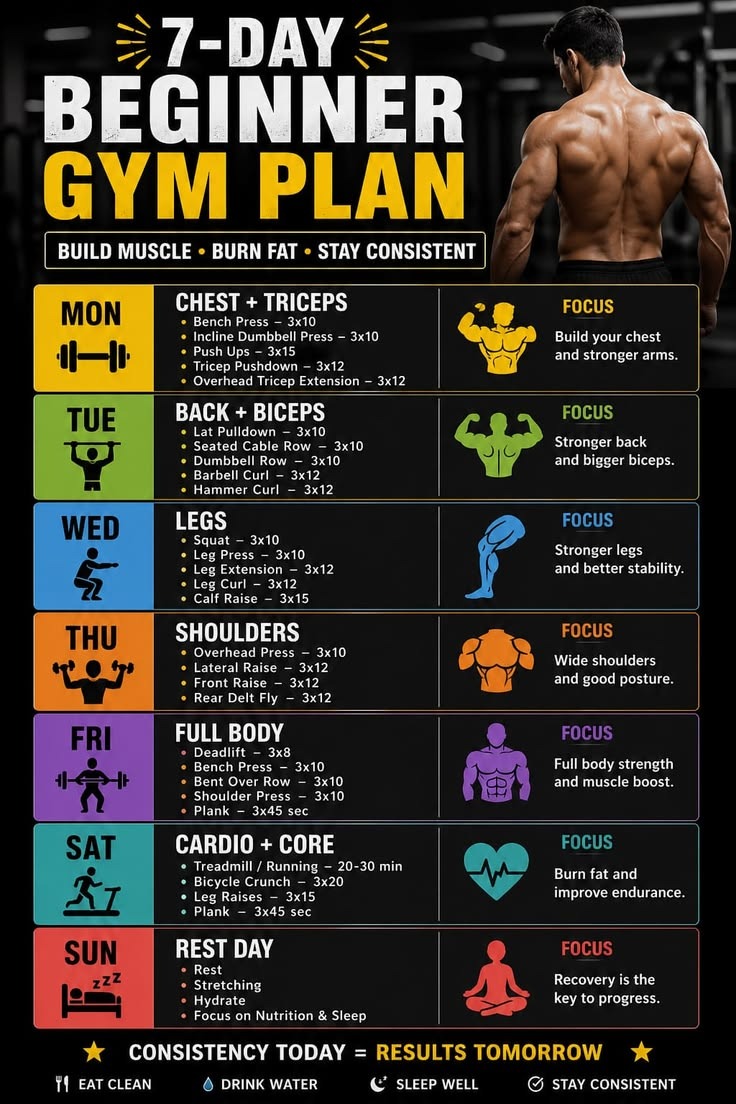
The following 7 day workout plan for beginners is designed to help you build strength, improve endurance, and develop a consistent fitness habit without overwhelming your body. Each workout takes about 30–45 minutes, including a warm-up and cool-down.
Before every workout:
Remember, consistency is more important than lifting heavy weights during your first few months.
A full-body workout is one of the best ways to start the week because it trains multiple muscle groups while teaching fundamental movement patterns.
This beginner full body workout routine focuses on compound exercises that improve strength and coordination.
Bodyweight Squats
Strengthens:
Push-Ups
Modify using knees if necessary.
Targets:
Walking Lunges
Improves:
Dumbbell Rows
Strengthens:
Plank
Hold for:
Builds core stability and posture.
Stretch:
This is an excellent workout for the day and serves as a great starting point for any day by day gym workout chart.
Today’s workout focuses on building upper-body strength while reinforcing proper lifting technique.
This session is ideal for anyone beginning a beginner muscle building workout plan.
Dumbbell Chest Press
3 × 10
Seated Shoulder Press
3 × 10
Lat Pulldown
3 × 10
Bicep Curls
3 × 12
Triceps Pushdowns
3 × 12
Farmer’s Carry
Walk 30–40 seconds × 3 rounds
Focus on:
Increase weight only after completing all repetitions comfortably.
This routine also fits well within a beginner bodybuilding program because it builds a solid strength foundation before progressing to heavier training.
Midweek is a great opportunity to improve cardiovascular fitness while strengthening your core.
Cardio supports:
Choose one:
If you’re comfortable with slightly higher intensity, include beginner-friendly HIIT.
Example:
Repeat 8–10 rounds.
Dead Bug
3 × 12
Bird Dog
3 × 10 each side
Side Plank
20–30 seconds
Bicycle Crunch
3 × 15
Reverse Crunch
3 × 12
Many beginners ask, how much cardio should I do a week?
Most health organizations recommend at least 150 minutes of moderate-intensity aerobic activity each week or 75 minutes of vigorous activity, combined with strength training.
If your primary goal is fat loss, consistency matters more than doing excessive cardio.
Another common question is what is the best time to workout for weight loss?
Research suggests that the best time is simply the time you’ll consistently stick with. Morning, afternoon, or evening workouts can all support weight loss when paired with proper nutrition.
For people balancing running and strength training weekly schedule, alternating strength days with cardio days helps optimize recovery.
Strong legs improve balance, posture, athletic performance, and everyday movement.
Today’s Thursday workout focuses on the lower body.
Goblet Squats
3 × 12
Romanian Deadlifts
3 × 10
Glute Bridges
3 × 15
Calf Raises
3 × 20
Step-Ups
3 × 10 each leg
Stretch:
Following structured workout days of the week helps ensure every major muscle group receives adequate attention.
Friday combines strength training with mobility work to improve movement quality and reduce stiffness.
This workout follows the basic concept of a 7 day workout split.
Incline Push-Ups
3 × 12
Dumbbell Shoulder Press
3 × 10
Resistance Band Rows
3 × 12
Face Pulls
3 × 15
Include:
Spend 10 minutes stretching:
This balanced routine fits nicely into a beginner-friendly week workout split and creates an organized gym workout schedule that promotes both strength and flexibility.
A consistent gym schedule weekly prevents training the same muscles on consecutive days.
Recovery doesn’t always mean sitting on the couch.
In fact, gentle movement often helps muscles recover faster by improving circulation.
Your Saturday workout should feel refreshing rather than exhausting.
Choose activities such as:
Aim for:
30–45 minutes of light movement.
People often worry about taking a week off from working out.
Short breaks are completely normal and may even improve long-term progress by allowing your body to fully recover.
Similarly, taking a week off exercise after illness, injury, or intense training can be beneficial when done appropriately.
Even individuals working out 4 days a week or working out 4 times a week should include some form of active recovery.
Sunday focuses entirely on restoring your body before beginning another training week.
This day completes your 7 day workout schedule while emphasizing mobility and recovery.
Perform each stretch for 30–45 seconds.
Include:
Practice diaphragmatic breathing for five minutes.
Benefits include:
Add movements such as:
This flexibility session supports long-term joint health while preparing you for another productive training week.
Whether you’re following a 7 day fitness plan, seven day workout schedule, 7 day workout routine, or a 7 day gym workout plan, recovery days are just as important as strength days.
Remember, a 7-day gym workout plan doesn’t mean lifting heavy weights every day. Strategic recovery is what makes a 7 days gym plan sustainable over the long term.
Every successful fitness journey starts with consistency, not intensity. Women who are new to exercise don’t need complicated routines—they need a balanced program that develops strength, improves cardiovascular fitness, and builds confidence.
A 7 days workout plan for beginners women should combine resistance training, cardio, flexibility, and recovery throughout the week.
Example weekly schedule:
Monday
Full-body strength training
Tuesday
Upper-body workout
Wednesday
Cardio and core
Thursday
Lower-body strength
Friday
Light resistance training and mobility
Saturday
Walking or yoga
Sunday
Stretching and recovery
Goals may include:
Most exercises can be performed at home using:
A beginner workout program for women should prioritize proper form, gradual progression, and consistency rather than rapid results.
Men beginning a fitness program often focus on building muscle while improving overall strength.
The key is mastering the fundamentals before attempting advanced bodybuilding routines.
A balanced beginner workout program for men includes:
A sample workout schedule for men beginners may look like this:
Monday
Full body
Tuesday
Upper body
Wednesday
Cardio
Thursday
Lower body
Friday
Push/Pull
Saturday
Recovery
Sunday
Mobility
Focus primarily on compound exercises such as:
These movements stimulate multiple muscle groups and build a strong strength foundation.
A structured men’s beginner workout routine helps improve:
Following an organized gym exercise schedule for men also makes it easier to track progress and increase weights gradually.
Using a workout routine chart for men allows you to record sets, repetitions, and improvements over time.
Most successful weekly workout routines for men emphasize consistency over perfection, making steady progress week after week rather than chasing quick results.
Not everyone has the same lifestyle, work schedule, or fitness goals. While this guide focuses on a 7 day workout plan for beginners, there are several effective weekly workout schedules to choose from. The best routine is one you can follow consistently over the long term.
A workout schedule for 3 days a week is ideal for beginners with busy schedules or those just starting their fitness journey.
A simple plan could look like this:
Monday: Full-body strength workout
Wednesday: Cardio and core
Friday: Full-body strength workout
Benefits include:
If you’re new to exercise, three quality workouts each week can produce excellent results.
After several months of consistent training, some people transition to a 6 day gym workout routine.
A popular structure is the Push/Pull/Leg split:
Monday: Push (Chest, Shoulders, Triceps)
Tuesday: Pull (Back, Biceps)
Wednesday: Legs
Thursday: Push
Friday: Pull
Saturday: Legs
Sunday: Rest
A 6 day gym workout schedule allows each muscle group to be trained twice weekly while still providing one full recovery day.
Before following a 6 day a week workout plan, make sure your nutrition, sleep, and recovery habits are well established.
Although many experienced lifters enjoy working out 6 days a week, beginners should gradually build toward this level of training.
Whether you train three, five, or seven days each week, planning ahead makes it easier to stay consistent.
A balanced week workout plan should include:
Creating a realistic weekly work out plan also helps you avoid skipping workouts or training the same muscle groups on consecutive days.
Remember to schedule both workout days and recovery days. Recovery is when your body adapts and becomes stronger.
One of the most common questions beginners ask is whether working out 7 days a week is healthy.
The answer depends on what “working out” means.
If you’re performing heavy strength training every day, your body may not have enough time to recover.
However, if your weekly schedule includes:
then a 7 day workout plan for beginners can be both safe and effective.
When structured correctly, working out seven days a week may help:
Training intensely every day can lead to:
To make a workout seven days a week sustainable:
If you constantly feel exhausted, it may be time to reduce training volume.
So, should you workout 7 days a week?
For beginners, yes—but only if some of those days focus on recovery instead of intense exercise.
Many beginners believe longer workouts automatically produce better results.
In reality, workout quality matters much more than workout length.
Thirty-minute sessions are perfect for:
With focused effort, you can complete:
within half an hour.
This is the sweet spot for many beginners.
A 45-minute workout provides enough time for:
without causing excessive fatigue.
Longer sessions work well once your fitness level improves.
However, avoid extending workouts simply because you’re chatting or scrolling through your phone.
General recommendations:
People often ask how long do you spend at the gym.
For most beginners, 45–60 minutes is more than enough to make consistent progress.
If you’re wondering how to work out average time, remember that consistency matters far more than marathon gym sessions.
There are many beginner-friendly workout styles available today. Here are some of the most popular options.
The 3-3-3 workout plan generally involves:
Benefits:
Potential drawbacks:
The most popular choice classic weekly plan usually follows this structure:
Monday – Full Body
Tuesday – Upper Body
Wednesday – Cardio
Thursday – Lower Body
Friday – Strength & Mobility
Saturday – Active Recovery
Sunday – Stretching
Its popularity comes from balancing training intensity with adequate recovery.
A 2 week fitness program is ideal for:
Although dramatic physical transformations aren’t realistic in just two weeks, beginners often notice:
Students often have demanding schedules, making short workouts the most practical option.
A 1 week fitness plan for students might include:
Consistency is more valuable than long workouts during busy academic periods.
One of the biggest mistakes beginners make is expecting life-changing results within a month.
After 1 year of working out consistently, many people experience:
Long-term consistency always beats short-term intensity.

Exercise alone won’t maximize your results.
A balanced meal and workout plan supports:
Aim to include protein with every meal.
Good choices include:
Carbohydrates fuel your workouts.
Choose:
Healthy fats support hormone production.
Examples include:
Drink water consistently throughout the day.
Hydration improves:
After exercise, combine:
This helps replenish energy stores and supports muscle repair.
Everyone makes mistakes when starting a fitness routine, but recognizing them early can help you avoid setbacks.
Common mistakes include:
Focus on learning proper technique before increasing workout intensity.

Motivation comes and goes, but consistency creates lasting results.
Here are practical ways to stay on track:
Remember, missing one workout doesn’t ruin your progress. Simply return to your routine the next day.
Start with basic compound exercises, learn proper form, warm up before every workout, and use light weights until you’re comfortable with the equipment. Don’t hesitate to ask gym staff for guidance if needed.
Most beginners benefit from exercising 3–5 days per week, while including active recovery or stretching on the remaining days. The ideal number depends on your fitness level and recovery.
Yes, as long as not every day is high intensity. A balanced 7 day workout plan for beginners includes strength training, cardio, flexibility, and active recovery to help prevent overtraining.
Aim for at least 150 minutes of moderate-intensity cardio or 75 minutes of vigorous-intensity cardio per week, combined with strength training for overall fitness.
The best time is whenever you can exercise consistently. Morning, afternoon, or evening workouts can all support weight loss when paired with healthy nutrition and regular activity.
Most beginners achieve excellent results with 45–60 minute workouts that include a warm-up, strength training, and cool-down.
Yes, beginners often experience noticeable strength gains and modest muscle development within the first month, especially when combining resistance training with adequate protein intake and recovery.
Both can be highly effective. Home workouts offer convenience and flexibility, while gym workouts provide access to a wider variety of equipment. The best option is the one you’ll consistently follow.
Start by identifying your fitness goals, schedule strength and cardio sessions throughout the week, include rest or active recovery days, and gradually increase intensity as your fitness improves.
Before exercise, eat a balanced meal or snack containing carbohydrates and some protein about 1–3 hours beforehand. After your workout, consume protein along with healthy carbohydrates to support muscle recovery and replenish energy.